Deontic Logic for Agent Permissions: A Formal Framework for AI Agent Governance
The fundamental question of what agents are permitted to do remains governed by ad-hoc JSON schemas and vibes-based access control. Wesley Hohfeld's decomposition of rights into eight fundamental relations—and deontic logic's formal operators—provide exactly the rigor AI agent governance needs.
The AI agent revolution has a dirty secret: we're building autonomous systems with the permission models of a 1990s file server. While we obsess over prompt engineering and tool calling, the fundamental question of what agents are permitted to do—and more importantly, why—remains governed by ad-hoc JSON schemas and vibes-based access control.
I've spent decades working at the intersection of legal informatics and software architecture. My early work on graphical notations for legal norms using deontic logic and Hohfeldian analysis wasn't just academic exercise—it was building formal tools for reasoning about rights, duties, and permissions. Three decades later, these same tools are exactly what we need to bring rigor to AI agent governance.
The Model Context Protocol (MCP) represents a significant step forward in standardizing agent-tool interaction, but its authorization model inherits the same conceptual poverty that plagues the rest of the industry.
Let's fix that.
The Hohfeldian Framework: Legal Relations as Permission Primitives
Wesley Newcomb Hohfeld, writing in the early 20th century, performed one of the most important analytical feats in legal philosophy: he decomposed the vague concept of "rights" into eight fundamental legal relations. This taxonomy has stood the test of a century of legal analysis because it captures something true about the structure of normative relationships.
The Eight Fundamental Relations
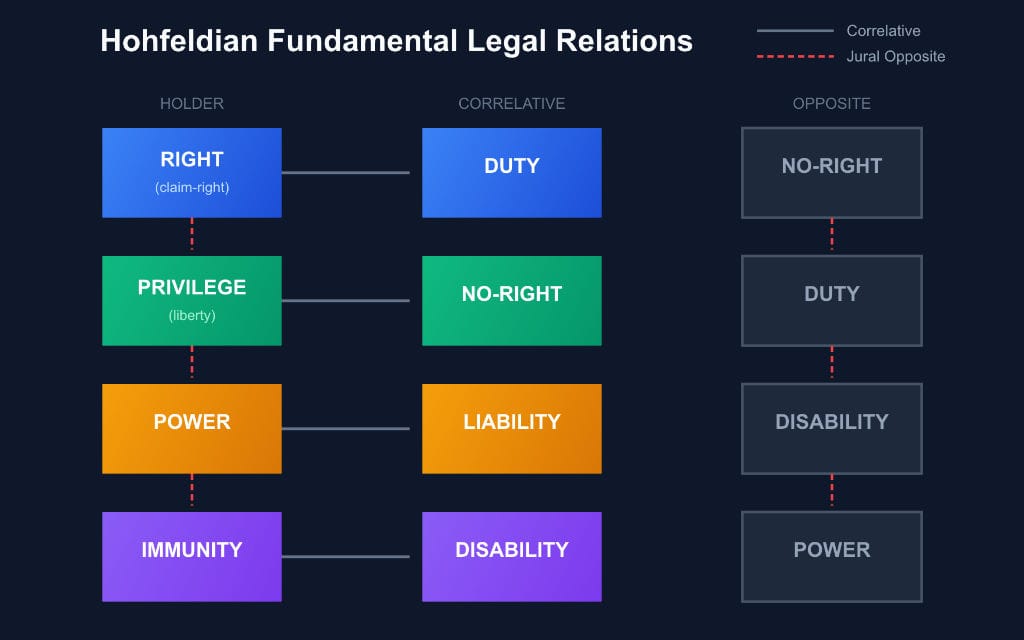
Hohfeld identified four pairs of correlative relations:
The genius here is recognizing that these aren't just abstract categories—they're computationally meaningful. Every permission statement can be decomposed into these primitives, and every permission interaction follows predictable algebraic rules.
Right-Duty Correlation: If Agent A has a right that Agent B perform action X, then Agent B has a correlative duty to perform X. This isn't philosophy—it's a constraint that must be enforced at runtime.
Privilege-NoRight Correlation: If Agent A has a privilege to perform action X, no other agent has a right that A not perform X. Privileges are permission-without-obligation—the agent may act but need not.
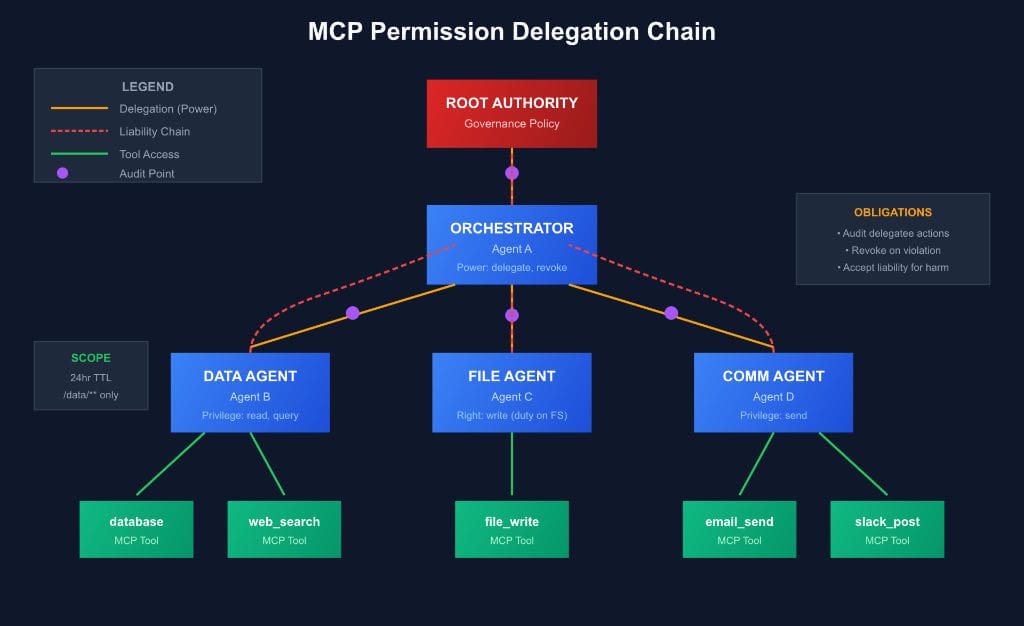
Power-Liability: The most important relation for agent systems. If Agent A has power to change Agent B's normative position (grant permissions, revoke access, modify capabilities), then B is liable (under a liability) to have its position changed. This is delegation, authorization, and governance in formal dress.
Immunity-Disability: The inverse of power. If Agent A has immunity from Agent B's attempted normative changes, then B is under a disability—it lacks the power to affect A's position.
Why This Matters for Agents
Consider a typical MCP scenario: an agent needs to read a file, modify a database, and send an email.
Current authorization asks: "Does the agent have permission?"
The Hohfeldian analysis asks something richer:
Does the agent have a privilege to read (it may read, but needn't)?
Does the agent have a right to read (some other entity has a duty to provide access)?
Does the agent have a power to grant sub-agents read access?
Does the agent have immunity from having its read access revoked during execution?
These distinctions aren't academic. They determine failure modes, recovery strategies, and accountability chains.
Deontic Logic: From Relations to Calculus
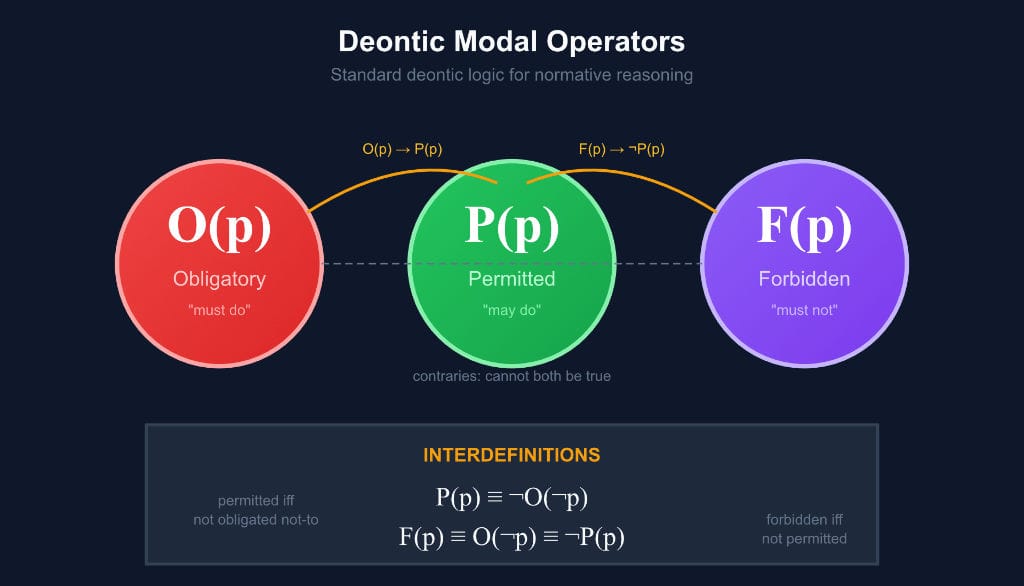
Deontic logic formalizes normative concepts—obligation, permission, prohibition—using modal operators. The standard operators are:
O(p): It is obligatory that p
P(p): It is permitted that p
F(p): It is forbidden that p (equivalent to O(¬p))
The symbol ¬ is the logical negation operator, commonly read as "not." Meaning if P is a proposition, then ¬P (or ¬ P) is the proposition that is true when P is false, and false when P is true. It flips the truth value. So, if P represents "It is raining," then ¬P means "It is not raining."
With the standard inter-definition: P(p) ≡ ¬O(¬p) and F(p) ≡ ¬P(p).
These three concepts are connected: Here’s a plain-English version:
If something is allowed, it means you don’t have to avoid it.If something is forbidden, it means it’s not allowed.
In plain English: When A delegates read access on resource R to B within scope S, A becomes obligated to audit B's actions A is obligated to revoke access upon violation, and A is liable for damages arising from B's actions.
This is accountability with teeth.
The Closure Problem
Deontic systems must also address the closure problem: what is the normative status of actions not explicitly addressed?
Two approaches:
Permissive closure: Everything not forbidden is permitted. Prohibitive closure: Everything not permitted is forbidden.
For agent systems, the answer is contextual:
A general-purpose assistant might operate under permissive closure with explicit prohibitions.
A financial trading agent operates under prohibitive closure with explicit permissions
The MCP authorization model needs to express this distinction.
Mapping Hohfeld's Framework to MCP Authorization
The Model Context Protocol defines tools, resources, and prompts. Let's map the Hohfeldian relations onto this structure.
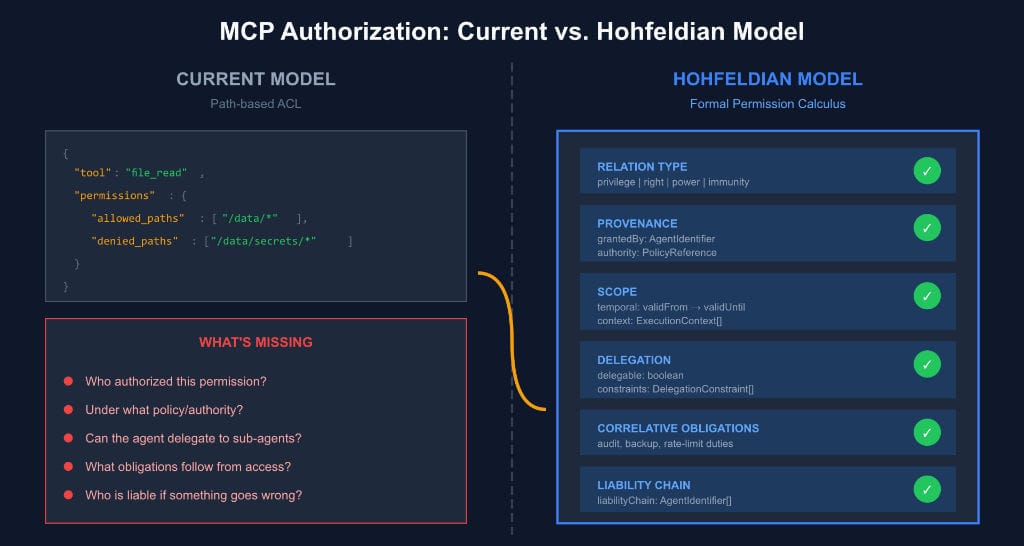
This is path-based ACL thinking. It tells us what but not why, who authorized it, under what conditions, or what happens when things go wrong.
Hohfeldian MCP Authorization (Proposed)
interface HohfeldianPermission {
   // The normative relation type
   relation: 'right' | 'privilege' | 'power' | 'immunity';

   // The correlative obligation (for rights) or liability (for powers)
   correlative?: {
     bearer: AgentIdentifier;
     content: Obligation | Liability;
   };

   // What action on what resource
   action: Action;
   resource: ResourcePattern;

   // Temporal and contextual bounds
   scope: {
     validFrom: Timestamp;
     validUntil: Timestamp;
     contexts: ExecutionContext[];
     conditions: Condition[];
   };

   // Provenance chain
   grantedBy: AgentIdentifier;
   grantedUnder: AuthorityReference;
   delegable: boolean;
   delegationConstraints?: DelegationConstraint[];

   // Accountability
   auditRequirements: AuditSpec;
   liabilityChain: AgentIdentifier[];
 }
The Permission DSL
The natural next step is to define a domain-specific language (DSL) for expressing agent permissions. Here's a simple example using a straight-forward declarative syntax:
// Permission declaration
permission FileReadPrivilege {
relation: privilege
agent: DataAnalysisAgent
action: read
resource: /data/analytics/**
scope {
valid: 2024-01-01 to 2024-12-31
context: [production, staging]
condition: request.purpose in ["reporting", "analysis"]
}
granted_by: SystemAdmin
authority: DataGovernancePolicy.section_3_2
delegable: false
}
// Delegation chain
delegation AnalyticsToVisualization {
from: DataAnalysisAgent
to: VisualizationAgent
permission: FileReadPrivilege
constraints {
scope_restriction: resource = /data/analytics/charts/**
temporal_restriction: duration <= 1 hour
audit: full_trace
}
obligations {
delegator_must: [audit_access, revoke_on_anomaly]
delegatee_must: [log_all_reads, respect_rate_limits]
}
}
// Power declaration
power DelegateReadAccess {
relation: power
holder: TeamLeadAgent
// What normative changes can be made
can_create: privilege where {
action in [read]
resource matches /team_data/**
}
// Who is liable to these changes
liability_bearers: [TeamMemberAgent]
// Limits on power exercise
constraints {
max_delegation_depth: 2
requires_approval_above: 10 resources
}
}
// Immunity declaration
immunity CoreSystemProtection {
relation: immunity
holder: AuditAgent
// What powers cannot affect this agent
immune_from: [
revoke_access where granted_by = SystemAdmin,
modify_permissions where resource = /audit/**
]
// Who is under correlative disability
disabled_agents: [*, except: SuperAdmin]
}
This DSL makes several things explicit that are currently implicit or absent in MCP agent authorization:
Relation type distinguishes can-do (privilege) from must-enable (right) from can-change (power) from cannot-be-changed (immunity).
Provenance establishes who authorized what under which policy—essential for audit and accountability.
Delegation constraints specify exactly how permissions can flow through agent hierarchies.
Correlative obligations automatically generate the duty-side of rights and the liability-side of powers.
Operational Semantics: Making It Run
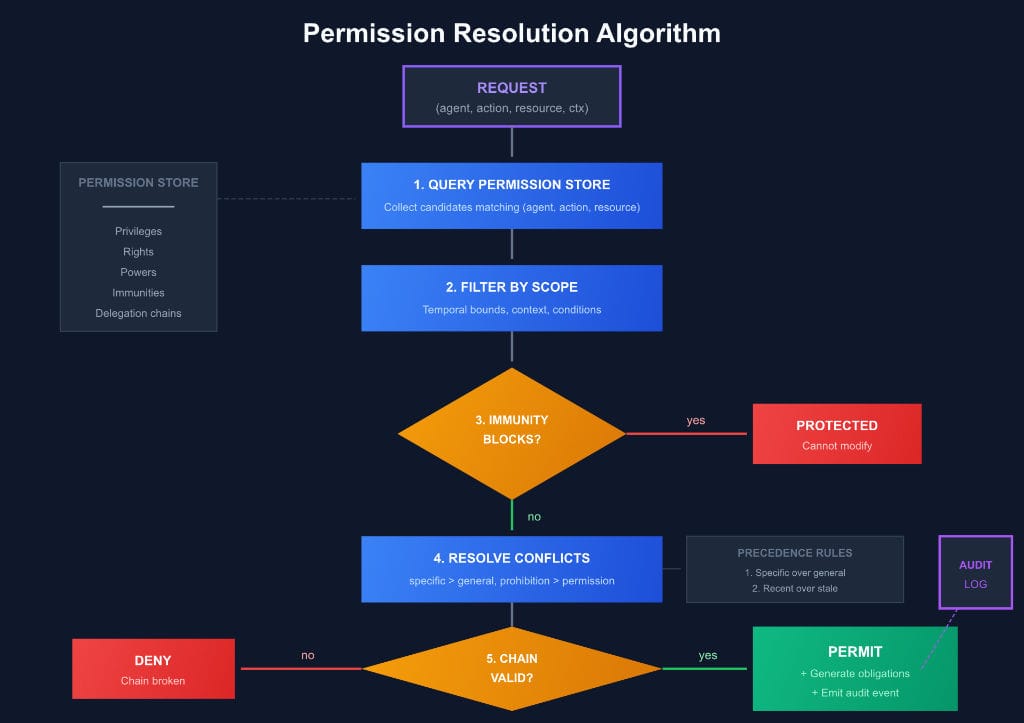
A formal framework is useless if it can't be evaluated at runtime. Here's the operational semantics for permission checking:
Delegation Chain Validation
The most complex operation is validating delegation chains:
Governance Implications: Accountability When Agents Fail
The formal framework enables precise answers to governance questions that are currently hand-waved:
Who Owns Agent Behavior?
The liability chain in each permission explicitly specifies ownership. When Agent C acts under a permission delegated from B who received it from A:
liability_chain: [C, B, A]
Damage assessment follows this chain. If C causes harm:
C is immediately responsible for the action
B is responsible for inadequate oversight (violated audit obligation)
Maintains the permission store with efficient indexing
Provides the resolvePermission API
Generates audit events
Enforces obligation chains
Phase 4: Governance Dashboard
Surface the formal model in human-understandable terms:
Visualize delegation chains
Alert on permission anomalies
Support delegation approval workflows
Enable "what-if" permission analysis
Conclusion: Formal Methods for Practical Governance
The AI agent ecosystem is building increasingly powerful autonomous systems on governance foundations of sand. We've been here before—in the early days of computing, access control was similarly ad-hoc until formal models (Bell-LaPadula, Biba, Clark-Wilson) brought rigor to security policy.
Hohfeldian analysis and deontic logic provide the same formal foundation for agent permissions. They're not just academic tools—they're operational frameworks that:
Decompose vague permission concepts into computationally tractable primitives
Compose complex authorization policies from well-understood building blocks
Verify delegation chains and obligation satisfaction
Audit with full provenance and accountability
Reason about permission interactions and conflicts
The Model Context Protocol is the right foundation for standardizing agent-tool interaction. Adding a formal permission calculus—grounded in a century of legal analysis—transforms it from a communication protocol into a governance framework.
The industry desperately needs this. Let's build it.