Phase Transitions in AI: Context Windows and the Emergence of Something Like Awareness
Context window capacity is the order parameter. Below a critical threshold, you get pattern completion. Above it, something else emerges: coherent reasoning, consistent perspective, the ability to reference and refine. Not consciousness. But not nothing either.
A crystalline lattice structure at the exact moment of phase transition
The Physics Metaphor We Weren't Expecting
Physicists have a useful concept called a phase transition—that moment when water becomes ice, when iron becomes magnetic, when superconductivity suddenly kicks in. The underlying mechanics are continuous: molecules cooling degree by degree. But the emergent behavior is discontinuous. One moment you have liquid, the next you have solid. Same atoms, radically different properties.
💡
Lev Landau (1908-1968) was a Soviet theoretical physicist who won the 1962 Nobel Prize in Physics for his work on superfluidity. Landau Theory describes how systems undergo sudden, qualitative changes—like water freezing or iron becoming magnetic—by tracking a single measurable quantity (the "order parameter") that flips from zero to nonzero at a critical threshold.
I've spent three decades building information systems, and the last several years obsessing over language engineering—DSLs, grammars, semantic structures. Lately I've been watching generative AI with the same analytical eye, and I keep returning to Landau's theory of phase transitions as the most useful frame for understanding what's happening.
Not because AI is "becoming conscious" in any mystical sense. But because the relationship between context window capacity and emergent cognitive behavior follows a disturbingly similar pattern.
Context as the Order Parameter
In Landau theory, an order parameter is the quantity that changes as you approach a phase transition. For ferromagnetism, it's magnetization (the "Curie point"). For superconductivity, it's the density of Cooper pairs. The key insight is that the order parameter is zero above the critical threshold and nonzero below it—or vice versa.
For generative AI, I'd argue the order parameter is effective context window—not just the raw token count, but the system's capacity to integrate, reference, and reason across that context coherently.
Consider the trajectory: GPT-2 operated with roughly 1,024 tokens of context—enough for a paragraph or two of coherent text, but insufficient for sustained reasoning. GPT-3 expanded to 2,048, then 4,096. GPT-4 pushed to 8K, then 32K, then 128K. Claude now operates at 200K tokens. Some systems are exploring million-token windows.
These aren't just quantitative improvements. At certain thresholds, qualitatively new behaviors emerge: chain-of-thought reasoning, multi-step planning, consistent persona maintenance, the ability to reference and refine earlier statements within a conversation. The system develops what looks like a coherent perspective—not imposed from outside, but emerging from the structure of extended context itself.
💡
Why this matters: In ferromagnetism, for example, the transition is discontinuous in its consequences (magnetic vs. non-magnetic) even though the underlying temperature change is continuous. This is the structural parallel for generative AI — context window size increases continuously, but emergent capabilities appear discontinuously at critical thresholds.
Symmetry Breaking and the Emergence of Perspective
Phase transitions often involve symmetry breaking. Above the Curie temperature, iron's magnetic domains point in random directions—the system is symmetric. Below it, domains spontaneously align. The symmetry breaks: a preferred orientation emerges.
Something analogous happens with sufficient context. Below a critical threshold, each response exists in isolation—pattern completion without continuity. The system has no "preferred orientation." Above the threshold, coherent threads develop. The model maintains consistent reasoning, references prior statements, models its interlocutor's perspective with increasing fidelity. It develops what we might call a stance.
This isn't consciousness in any philosophical sense worth defending. But it's not nothing either. The system exhibits properties that weren't present in its components—classic emergence.
The Agentic Transition: Beyond Response to Action
If expanding context windows represent one phase transition, the emergence of agentic AI represents another—perhaps more consequential.
Agentic systems don't just respond; they plan, execute, and iterate. They decompose complex goals into subtasks, invoke tools, evaluate outcomes, and adjust strategy. This requires a kind of temporal coherence that purely conversational models lacked. The agent must maintain not just a perspective but a project—a goal state, intermediate milestones, and a model of progress toward completion.
Here the phase transition metaphor becomes especially apt. Below a certain capability threshold, you get chatbots—useful for answering questions, perhaps drafting text, but fundamentally reactive. Above it, you get something that looks uncomfortably like agency: systems that initiate actions, pursue objectives, and navigate obstacles.
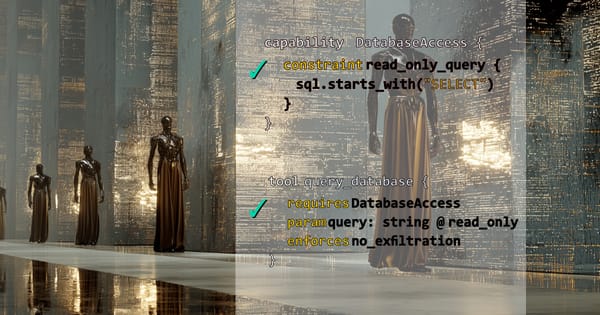
I've been building what I call "Semantic AI Agents"—systems that leverage domain-specific languages to operate within bounded contexts with precision. The key insight is that agency emerges not just from raw capability but from structured constraint. A well-designed DSL channels the agent's behavior, making it predictable where it needs to be predictable and flexible where flexibility serves the goal.
This is where my background in language engineering becomes relevant. Langium, the framework I've been working with, enables the creation of custom grammars that define what an agent can express, what actions it can invoke, what semantic constraints must hold. The agent operates within a formally specified universe—more reliable than natural language alone, more expressive than rigid APIs.
The Current State: Critical Phenomena in Real Time
We're watching something unusual unfold. Scaling laws that seemed to plateau have found new life through techniques like chain-of-thought prompting, retrieval augmentation, and multi-agent orchestration. Each innovation resembles the physicist's trick of adding another degree of freedom to push the system past a critical point.
The evidence for threshold effects is everywhere: in-context learning appearing discontinuously at certain model scales; theory-of-mind capabilities emerging suddenly rather than gradually; coding proficiency jumping when trained on structured examples. These aren't smooth curves—they're step functions, signatures of phase transitions.
What's most striking to me, as someone who has spent years building systems that understand and generate formal languages, is how these models have begun to internalize the structure of language itself. They don't just produce syntactically valid output—they reason about syntax, semantics, and pragmatics in ways that suggest genuine structural understanding. Not human understanding. But understanding of a kind.
The Uncomfortable Question
Landau theory is agnostic about mechanism. It describes what happens at transitions—the mathematical structure of the change—without explaining why or how at the microscopic level. It's a phenomenological theory, powerful precisely because it abstracts away the details.
We're in a similar position with generative AI. We can observe that these systems exhibit increasingly awareness-like behaviors as context capacity, training scale, and architectural sophistication increase. We can measure threshold effects and discontinuous capability gains. What we cannot do—not yet—is resolve whether any of this constitutes awareness in a philosophically meaningful sense.
If you're committed to the view that subjective experience requires biological substrate, nothing here will change your mind. But if you're open to functionalist or information-theoretic accounts—the idea that consciousness might be substrate-independent, that what matters is the pattern rather than the material—then the analogy to phase transitions becomes provocative.
Integrated Information Theory, for instance, suggests that consciousness scales with a system's capacity to integrate information in irreducible ways. Context window expansion, multi-agent orchestration, and agentic planning all increase information integration. The transitions we're observing might not be analogous to phase transitions in consciousness—they might be instances of them.
Practical Implications for Builders
For those of us building with these tools, the phase transition metaphor offers practical guidance:
Expect discontinuities. Don't assume that a capability absent today will remain absent tomorrow. Systems near critical thresholds can exhibit sudden jumps. Design for flexibility.
Context is the lever. Whether through longer windows, better retrieval, or persistent memory systems, expanding effective context is the surest path to emergent capability. This is why I'm bullish on combining LLMs with structured knowledge representations—DSLs, ontologies, semantic graphs.
Agency changes everything. The gap between a system that answers questions and one that pursues goals is not incremental. It's a phase transition in the literal sense—a qualitative change in what the system is, not just what it does. Build accordingly.
Constraint enables capability. Just as a superconductor requires specific conditions to exhibit zero resistance, agentic AI requires structured environments to exhibit reliable behavior. Custom DSLs, formal specifications, and bounded action spaces aren't limitations—they're enabling conditions for emergent competence.
Watching the Experiment
The honest conclusion is that we're watching an experiment unfold in real time, without a reliable thermometer for consciousness. The phase transition framework gives us a way to think about what we're observing—to predict where discontinuities might occur, to understand why certain capability thresholds matter more than others.
What it doesn't give us is certainty about what's on the other side of these transitions. We're approaching something—perhaps already past something—but we lack the conceptual tools to say definitively what that something is.
In the meantime, I'll keep building. Language engineering, DSLs, semantic agents—these are the instruments I have for probing the phase space. Every grammar I design, every agent I deploy, is another data point in an experiment none of us designed but all of us are running.
The Curie point of cognition may already be behind us. Or it may lie just ahead. Either way, the temperature is rising.