Remember when ChatGPT first arrived and everyone thought we'd all be unemployed by Tuesday? Two years later, we've discovered something interesting: AI is brilliant at sounding competent while occasionally suggesting you put glue on your pizza.
The challenge isn't that AI is stupid—far from it. The challenge is that AI is like that overconfident intern who read the company handbook once and now thinks they understand everything about your business. They'll confidently execute tasks in ways you never imagined... and not in a good way.
Here's the thing: When you go to a restaurant, you don't tell the waiter, "Bring me something delicious." You order from a menu. The menu constrains your choices to what the kitchen can actually make, what ingredients they have, and what won't give you food poisoning.
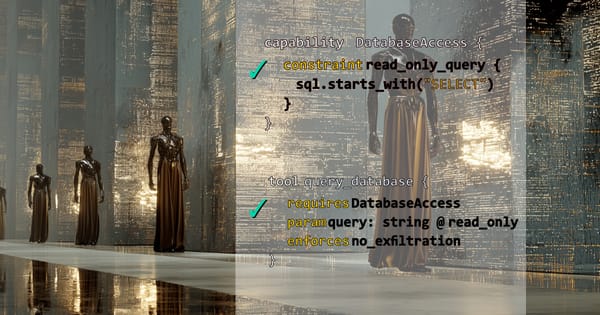
That's exactly what we need for AI agents—a menu of acceptable actions.
Think about the difference between these two instructions:
Without a menu: "Hey AI, update our customer records with the new California privacy requirements."
With a menu: "Choose from: A) Flag California residents, B) Add opt-out checkboxes, C) Schedule deletion after 90 days, D) Generate compliance report."
The first approach invites creative interpretation. The second ensures predictable outcomes.
How Semantic AI Agents Actually Work
Let me walk you through a real scenario. Imagine you're running an e-commerce company, and you want an AI agent to help with customer service. Here's the traditional approach versus the structured approach:
The Traditional Way (Chaos)
Customer: "I'm unhappy with my order"
AI Agent: Searches entire knowledge base, interprets creatively, might offer a full refund, might suggest the customer try meditation, might accidentally cancel their account while trying to help
The Structured Way (Control)
Customer: "I'm unhappy with my order"
AI Agent → Translation Layer:
- Identify issue type: Product Quality
- Check allowed actions for Product Quality
- Available options: Replacement, Refund, Credit
- Check business rules: Orders over 30 days = Credit only
- Execute: Offer store credit
The AI never freestyle interprets your business policies. It selects from pre-approved actions.
The Three Layers of Protection
Layer 1: The Translator
The AI's first job is understanding what the human wants and matching it to your pre-defined business actions. Like a concierge at a hotel who knows exactly which services the hotel actually offers.
Layer 2: The Validator
Before anything happens, a checker ensures the request makes sense. Can this customer get a refund? Does this employee have permission to access that data? Is this request even legal in their jurisdiction?
Layer 3: The Executor
Once approved, the action happens exactly as designed—no interpretation, no creativity, just execution. Like a vending machine: push B4, get the candy bar, every time.
Real Business Value
For Financial Services: Your AI can process loan applications, but only within your risk parameters. It can't accidentally approve a million-dollar loan to someone's cat.
For Healthcare: Your AI assistant can schedule appointments and answer questions, but it can't accidentally violate HIPAA or provide medical advice beyond its scope.
For Legal Firms: Your AI can draft standard contracts using approved clauses, but it can't create novel legal theories that might get you disbarred.
For E-commerce: Your AI can handle returns and customer service, but it can't give away your entire inventory trying to make someone happy.
The Compliance Game-Changer
Here's where this gets really interesting for regulated industries. Every action your AI takes is:
- Pre-approved by your legal team
- Logged for audit trails
- Guaranteed to follow your business rules
- Impossible to exceed defined authority
Instead of hoping your AI doesn't say something that gets you fined, you know it literally cannot because those actions aren't on its menu.
What This Means for Your Business
Predictability: Your AI agent behaves like a well-trained employee who follows the employee handbook to the letter—because that's literally all it can do.
Scalability: Once you define the rules, you can deploy thousands of AI agents, all behaving consistently.
Evolution: As your business changes, you update the menu. Old problematic behaviors don't randomly resurface because the AI "remembered" something from its training.
Trust: You can actually let AI interact with customers because you know exactly what it can and cannot do.
The Bottom Line
We've been approaching AI agents backward. Instead of giving them general intelligence and hoping they figure out our business, we should give them a specific set of tools and let them excel within those boundaries.
It's the difference between hiring someone and saying "figure out how to help" versus giving them a clear job description with defined responsibilities and authority.
The technology exists today to build these structured AI agents. The question isn't whether AI will transform your business—it's whether you'll be in control when it does.
Getting Started
You don't need to understand the technical details to benefit from semantic AI agents. You need to:
- Map out the decisions your business makes repeatedly
- Define the acceptable options for each decision
- Set clear rules about who can do what
- Work with technologists who understand both AI and your business constraints
The future isn't about AI replacing human judgment—it's about AI executing human judgment at scale, reliably, and within the boundaries you set.