New Book: The Law of Agents
Eight centuries of doctrine vs. eighteen months of AI.

– 4 min read

Eight centuries of doctrine vs. eighteen months of AI.

In the mid-1980s, while studying law and computational linguistics at the University of Michigan, I built an interactive expert system in LISP, running on a university mainframe, that recognized Wesley N. Hohfeld's fundamental jural relations in natural-language descriptions of legal cases. You could ask it whether a given relation held between two parties, and it would answer from what it had recovered from the prose. It worked, in a small way, on a small corpus. It produced no diagrams; you took the logic on faith.
Separately, as a post-graduate fellow at the Institute for Legal Documentation in Florence, I worked the other half of the problem without knowing it was a half. On paper, with no computer, I developed a graphical notation for expressing those same jural relations in a form a human reader could inspect at a glance. The two efforts were never joined. The software had no display layer; the notation had no software. I assumed both would age into a methodological footnote.
Now some forty years later, both turn out to have been about a problem nobody had yet built: software that takes actions on people's behalf. The Hohfeldian decomposition the LISP system recovered from prose is exactly the recovery step that production-grade agentic AI systems still fumble — what did this delegation actually change, jurally, between these parties? And the notation is exactly the human-inspectable form those systems lack for verifying what they recovered before acting. I spent four decades thinking I had two half-finished projects. It turns out I had one finished question, waiting for its subject matter to be invented.
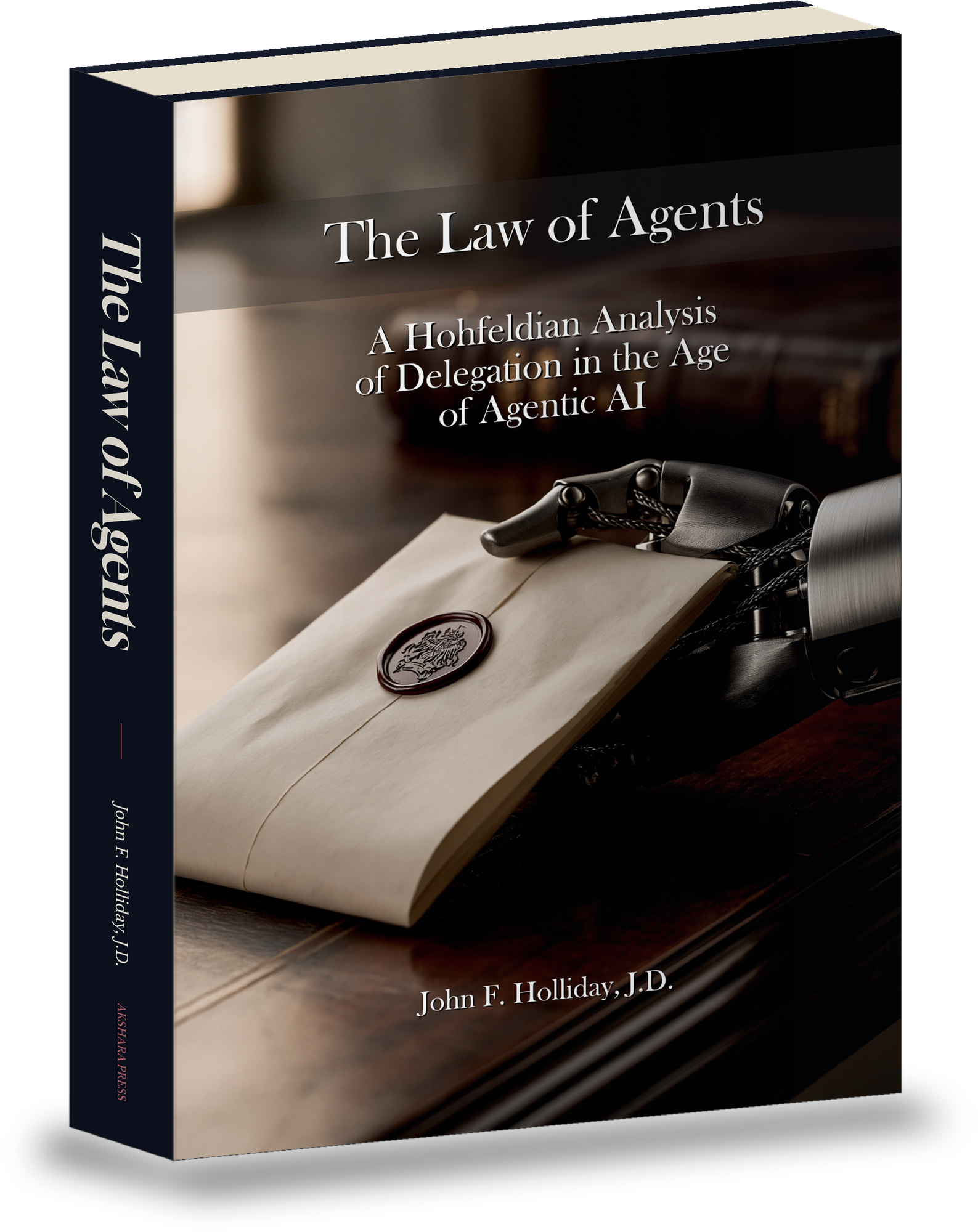
The Law of Agents: A Hohfeldian Analysis of Delegation in the Age of Agentic AI (January 12, 2027 - Hardcover & Digital Editions).
The book asks a question the AI industry has been answering badly by answering it accidentally: when a principal delegates authority to an agent, who bears the consequences?
Agency law has been working on that question since the thirteenth century.
Apparent authority, ratification, the duty of loyalty, respondeat superior — these are not analogies imported to make AI governance sound respectable. They are the accumulated case law of delegation under uncertainty, and they map onto agentic AI systems with uncomfortable precision. When an LLM invokes a tool nobody authorized, the doctrine already has a name for that. When a vendor accepts the benefit of an agent's unauthorized act, the doctrine already knows what happens next.
It is a treatise in the old-fashioned sense and unapologetic about it — sixty-two doctrines across three Parts, each stated as a single proposition, restated in plain language, and defended with citations to the primary sources.
The tag line is the honest summary: eight centuries of doctrine, eighteen months of AI. Agency law has been stress-tested by every relational novelty since the joint-stock company, and it has absorbed each one by recognizing it as a new arrangement within the framework rather than an exception to it. Nothing about tool-calling software changes that. What the moment demands is not new law. It is old law in a form the people building these systems can actually use.
That form is the method, and the method is why this book took the shape it did. I call it Hohfeldian Analytics™: every doctrine is decomposed into Hohfeld's fundamental jural relations, then written in a small domain-specific language, and every figure in the book is rendered by machine from that source.
The diagrams are not illustrations of the doctrine. They are the doctrine, compiled. Regular readers of my blog have already seen the pieces in motion — the correlatives at work, the argument that semantic drift between parties is a governance problem, the case that agent protocols need a type system.
The book is where those threads were heading all along.
The two audiences that keep having the same conversation without a shared vocabulary. General counsel and governance people, who know the doctrine but need it connected to what the systems actually do. And architects and engineers, who know what the systems actually do but keep discovering that their permission model and the law's authority model are different documents. The book is written so either can hand it to the other and point at a section number.
Between now and release day, my blog will run a series of posts, each taking one doctrine from the book and one live controversy in agentic AI and running them into each other: the case where an airline argued its own chatbot was a separate legal entity, why your OAuth scopes are not an authority model, what fiduciary law says about hallucination, why prompt injection is an agency problem before it is a security problem, and what a two-century-old distinction between a detour and a frolic decides about your off-task agent. Along the way, a tutorial teaches the notation itself, one bond at a time.
I did not predict agentic AI. I do not claim foresight, and I would likely distrust anyone who does. But the doctrines were ready — they have been ready for centuries — and the people doing the building deserve access to them in a form they can use.
If you want to be notified when the book ships...