Your Chatbot Is Not a Separate Legal Entity
Air Canada called its chatbot a separate legal entity. Agency law disposed of that argument eight centuries ago — and it governs your AI agents today.

– 6 min read

Air Canada called its chatbot a separate legal entity. Agency law disposed of that argument eight centuries ago — and it governs your AI agents today.

This post is drawn from The Law of Agents: A Hohfeldian Analysis of Delegation in the Age of Agentic AI (Akshara Press, January 12, 2027) — a three-part treatise that takes eight hundred years of agency doctrine and applies it to software that acts on people's behalf. Part I covers authority and delegation; Part II, the fiduciary duties an agent owes its principal; Part III, how loss is allocated when an agent harms a third party. Each post in this series takes one doctrine from the book and renders it using Hohfeldian Analytics™ — a diagram and a machine-checkable source form. More at law-of-agents.johnholliday.net.
On February 14, 2024, a small claims tribunal in British Columbia ordered Air Canada to pay Jake Moffatt $812.02. The airline's website chatbot had told him he could apply for a bereavement discount after the fact, once he had already flown to his grandmother's funeral. That was wrong. Air Canada's actual policy required the request before travel. The money at stake is trivial. The defense the airline raised is not.
Air Canada argued that it could not be held liable for information provided by "one of its agents, servants, or representatives — including a chatbot." Tribunal member Christopher C. Rivers called this "a remarkable submission" and rejected it in a sentence.
I open The Law of Agents with Moffatt v. Air Canada (§ 1.1) because the defense, not the damages, is the story. The case has been written up on nearly every legal blog on the continent. Most of that commentary focuses on the negligent-misrepresentation theory the tribunal actually used, which is fair — that is how the case was decided. What almost nobody has said is that Air Canada's argument was not merely remarkable. It was a category error about what an agent is. And companies deploying AI agents keep making versions of it:
Each of these is the Air Canada defense with better formatting.
Right result, wrong doctrine. Moffatt represented himself, and negligent misrepresentation was the claim he pleaded, so the tribunal analyzed it that way. That means working through four elements: the defendant owed a duty of care, the defendant breached it by supplying false information, the plaintiff reasonably relied on that information, and the plaintiff suffered a loss as a result. Every one of those elements has to be proven again, on new facts, in the next case. A future defendant will argue that its disclaimer eliminated the duty of care, or that a user who trusted a chatbot was not relying reasonably because he could have called a human. Negligence law is designed to leave those questions open until trial.
Agency law closes them at the outset. Under agency doctrine, a principal-agent relationship exists when three things are true: the principal manifests assent that another act for it, the agent acts on the principal's behalf, and the agent is subject to the principal's control. (Restatement (Third) of Agency § 1.01.) Once that relationship exists, the principal is bound by the agent's authorized acts. Not as a matter of case-by-case fact-finding, but as a matter of structure — that is simply what the relationship means.
This also changes what a disclaimer can accomplish. A principal cannot dissolve the relationship by announcing that it has done so. If the principal wants to narrow what the agent may do, it must actually limit the agent's authority and communicate that limit to the third parties who deal with the agent. The practical consequence is large: a negligence regime produces systems that must be litigated, while an agency regime produces systems that can be designed.
The doctrine is older than the corporation. Qui facit per alium, facit per se — one who acts through another acts himself (§ 1.6). The principle appears in the Digest of Justinian, passes into canon law through twelfth-century commentators, shows up in Bracton in the thirteenth century, and is organized into English law by Coke in the seventeenth. Every new way of arranging human activity over the last eight hundred years has tried to slip out from under it: the joint-stock company, the limited liability partnership, the franchise, the digital platform. None has managed it. The doctrine absorbs each newcomer by treating it as a new arrangement inside the framework rather than an exception to it.
That absorption is not a stretch here. Agency law has already dealt with actors operating at scale, with unpredictable behavior, and with no genuine subjective will of their own — corporate "will" is itself a legal fiction we invented and got comfortable with. It will handle AI agents the same way, whether or not the engineers building them ever learn the vocabulary.
Making the vocabulary precise. The method of this book is to take that vocabulary and sharpen it into something you can build on. I call the approach Hohfeldian Analytics™. Wesley Hohfeld, writing in 1913, argued that vague talk about "rights" actually conceals four distinct legal positions: right, duty, power, and liability — each paired with a correlative on the other side of the relationship. Every doctrine in this book is decomposed into those elements, then expressed in two forms a machine can check: a diagram, and a small domain-specific language.
Here is § 1.6 in the graphical notation:
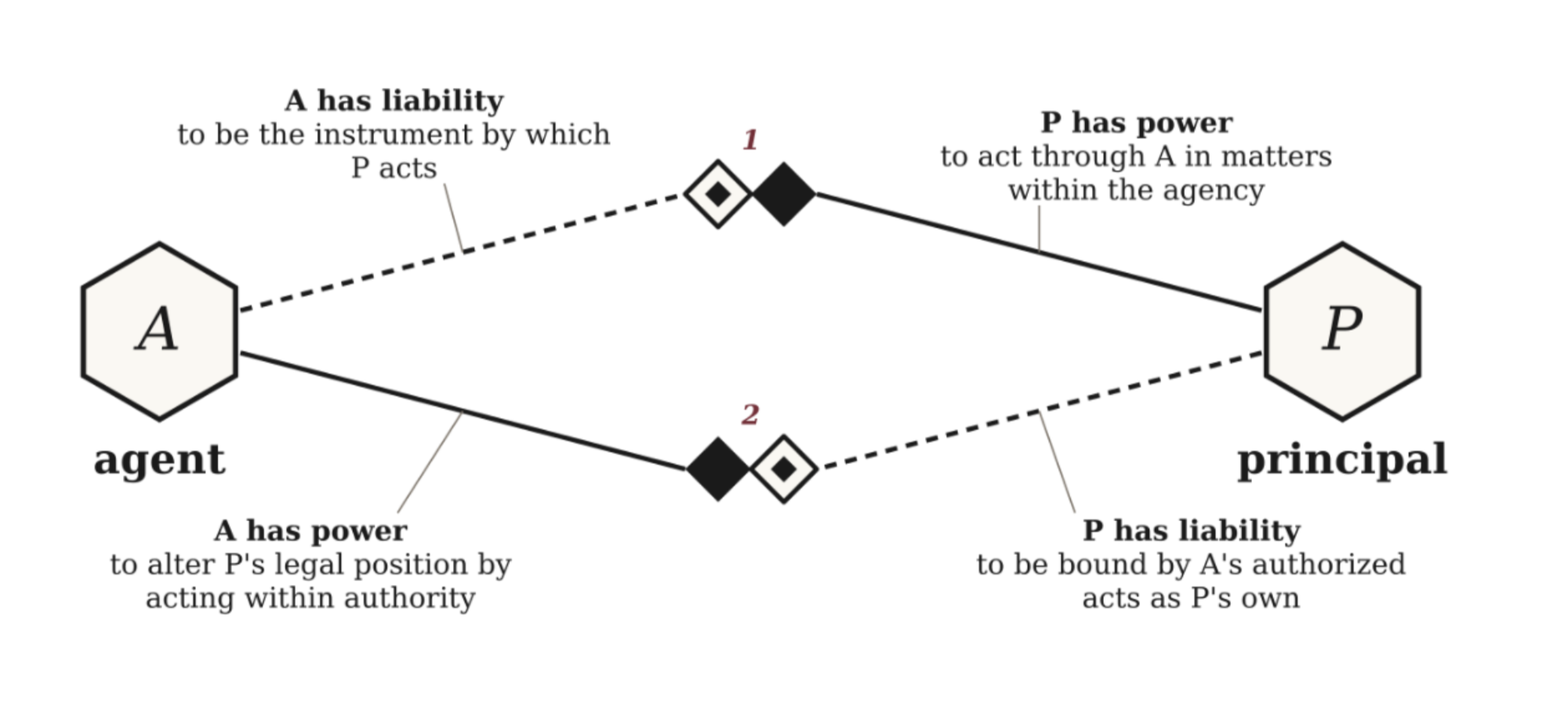
The parties appear as nodes — P, the principal, and A, the agent. Each numbered bond is one jural relation: the solid edge carries the active position (a power), and the dashed edge carries its correlative (the liability that necessarily accompanies it on the other party).
And here is the same doctrine in source form, exactly as it appears in the book's corpus:
doctrine "Qui Facit Per Alium" {

    maxim "He who acts through another acts himself."

    description "Two parties: principal (P), agent (A). The maxim treats P's authorized acts through A as P's own acts in law. The two correlatives capture (a) P's standing power to act through A, and (b) A's standing power to alter P's legal position by acting within authority — and P's correlative liability to be so altered."

    party P : "principal"
    party A : "agent"

    correlative "P's instrumental power" {
        P has power "to act through A in matters within the agency"
        A has liability "to be the instrument by which P acts"
    }

    correlative "A's binding power" {
        A has power "to alter P's legal position by acting within authority"
        P has liability "to be bound by A's authorized acts as P's own"
    }
}
Read the two correlative blocks and you have the whole maxim.
Start with what Hohfeld meant by a power. A power is the ability to change someone's legal position — to create a right, extinguish a duty, form a contract, transfer title. Its correlative, on the other side of the relationship, is always a liability. Be careful with that word. It does not mean owing money, which is how the term gets used in ordinary speech and in tort. Hohfeldian liability means only this: being subject to having your legal position changed by someone else's act. You can be liable in Hohfeld's sense and better off for it. The beneficiary of a gift is liable to receive it.
With that in place, the two bonds read cleanly.
Bond 1 runs from principal to agent. The principal holds a standing power to act through the agent. The agent, correlatively, is liable to serve as the instrument of that action — subject to being directed, instructed, and used to carry out the principal's purposes. This is the direction most people already have in mind when they picture an agency relationship. It is the intuitive half.
Bond 2 runs the other way, and it is the half Air Canada wished out of existence. The agent holds a power to change the principal's legal position by acting within the scope of its authority. The principal is correlatively liable — exposed to being bound by those acts as though the principal had performed them personally. Not vicariously, not derivatively. As its own.
That second bond is not an add-on to the relationship. It is the relationship. Strip it out and what remains is a tool, not an agent — something the principal operates rather than something the principal acts through. Air Canada's submission asked the tribunal to keep Bond 1, which the airline liked, while deleting Bond 2, which had become inconvenient. The two are not separable in that way. Whoever holds the power in Bond 1 holds the liability in Bond 2, and the maxim — qui facit per alium, facit per se — is just the compressed statement of both.
The Law of Agents: A Hohfeldian Analysis of Delegation in the Age Agentic AI is out January 12, 2027 from Akshara Press. If your systems act on anyone's behalf — and if they use tools, they do —the doctrine already governs them, whether or not your architecture diagram says so.