Your Tesla Changed While You Slept - So Did Your Duty of Reasonable Care
An over-the-air update changed your car's braking overnight. It also changed your legal duties. No doctrine has a name for that relation — agency, products liability, bailment all fail — and it now sits under every LLM agent deployment.
Sometime tonight, while your Tesla sits in the driveway, the company that built it may reach into it and change how it brakes. An over-the-air update can alter the vehicle's braking profile, its speed thresholds, its driver-monitoring aggressiveness, the boundaries of the operational envelope inside which its automation is designed to function. You will find out in the morning, if you find out at all, via a release note. You did not consent to the particular change, you cannot meaningfully refuse it, and you cannot inspect what it did.
That much is a technology story. Here is the legal story: when the update lands, your legal position moves. The duty of reasonable care you owe to every pedestrian, cyclist, and motorist near your vehicle is a duty whose practical content depends on how the machine behaves — and a third party just rewrote how the machine behaves. Your duties were modified overnight, by someone else, while you slept.
This article traces that relation through three settings — a driveway, a courtroom, and a bank — and gives it the only vocabulary precise enough to hold it: Wesley Hohfeld's. If you have never read a page of Hohfeld, good. You are the reader this article is for. The analysis will be labeled as we go, so you can always see exactly which analytical move is being made and why.
The case that almost saw it
Start with the courtroom. In Benavides v. Tesla, a Miami jury found in 2025 that Tesla bore a third of the fault for a fatal Autopilot crash. The verdict survived post-trial motions this February and is now on appeal to the Eleventh Circuit. The case was litigated as a products case, and correctly so. The driving system itself holds no legal position of any kind — it owes no duty, wields no power, occupies no square on the board — so agency doctrine never engages, and the case sounds entirely in tort.
But buried in that fact pattern is one genuine, primary, non-remedial legal relation that nobody litigated, and it is the most consequential thing in the case. It does not run from Tesla to the victim. It runs from Tesla to the owner. To see it, you need two words of Hohfeld's vocabulary — and only two.
A two-minute Hohfeld primer
In 1913, Yale law professor Wesley Newcomb Hohfeld published an article — 23 Yale L.J. 16 — complaining that lawyers use the word "right" for at least four different things, and that the confusion is not cosmetic. He sorted legal relations into precise pairs. The pair that matters here:
Power. The capacity to change someone else's legal relations by your own act. Signing a contract, firing an employee, revoking an offer, accepting a deed — powers all. The defining feature: the other party doesn't get consulted. Their legal position moves because you acted.
Liability. The correlative of power: the state of being susceptible to that change. No fault implied, no wrong required. "Liability" in Hohfeld's sense is not blame; it is exposure. If I hold a power over you, you sit in liability to me — full stop.
Every power has a liability on the other end, the way every debt has a creditor. That is the whole toolkit this article needs. Now apply it to the driveway.
Naming the relation
The over-the-air update capability is a Hohfeldian power — exactly, and not metaphorically.
Tesla's unilateral act — pushing an update — changes the behavior of the instrument through which the owner discharges his duty of care, and thereby changes what reasonable care consists of on tomorrow's commute. A driver who calibrated his following distance, his intervention reflexes, his trust in the system's stop-sign behavior against last month's software is holding a mental model of a machine that no longer exists. The duty is his. The content of the duty just moved. And the party who moved it stands outside the duty relation entirely.
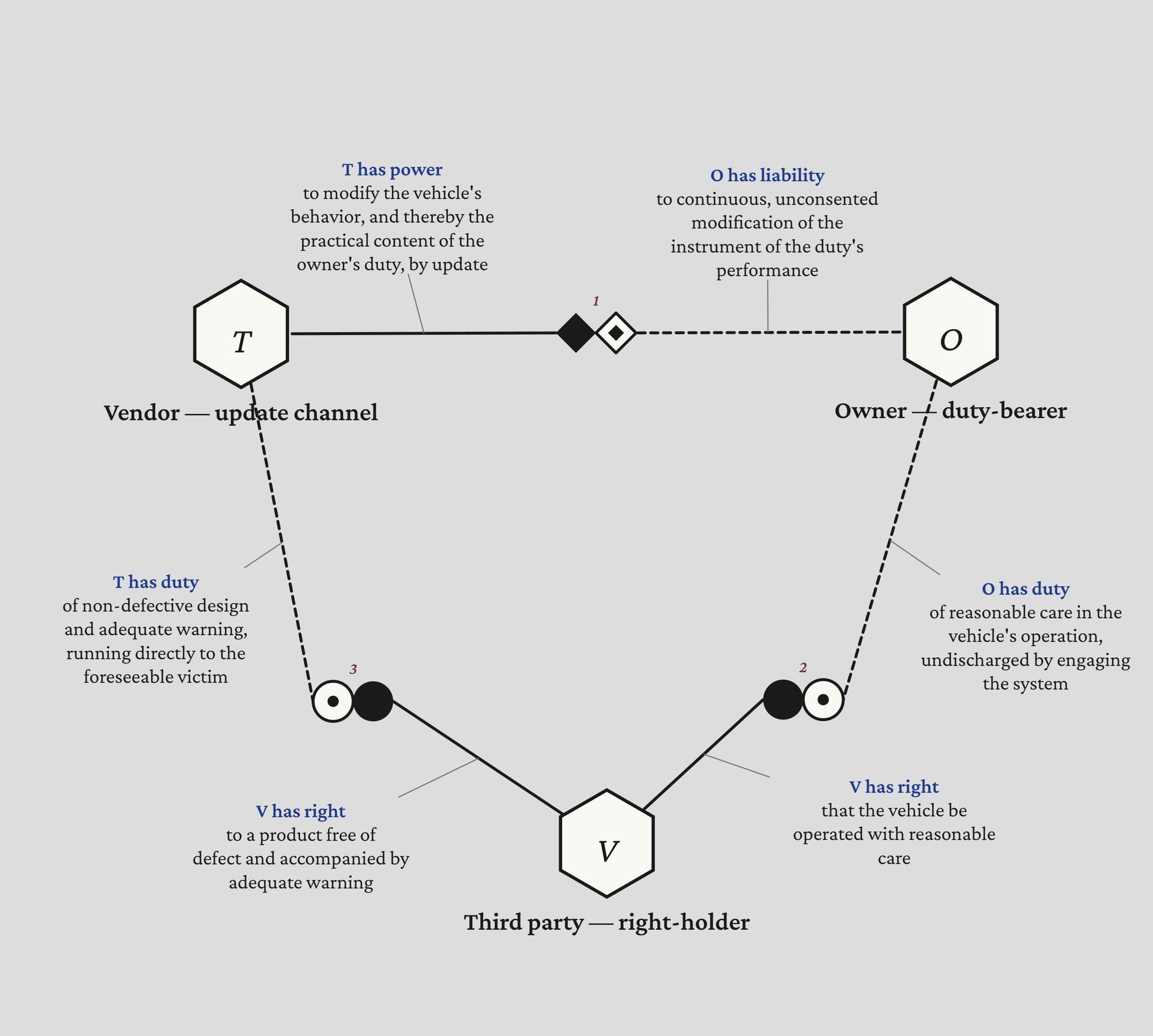
The Hohfeldian analysis, stated explicitly. Power-holder: Tesla. Content of the power: to alter, by unilateral act, the behavior of the vehicle — and therefore the practical content of the owner's duty of care. Liability-bearer: the owner. Character of the liability: continuous. It does not lapse overnight, mid-lease, or while the car is parked and locked. There is no moment at which the susceptibility switches off. Three structural features to hold onto: the power was never conferred (it came bundled in the firmware), it is irrevocable by the liable party, and it operates on the instrument of someone else's duty. Each of those features will matter in a moment.
Figure 1 — Tesla holds a power over the owner (over-the-air update, not conferred, irrevocable); the owner bears a non-delegable duty of reasonable care to third parties; Tesla owes third parties only a product-liability duty. The party who rewrites the duty's content stands outside the duty relation.
Three doctrines that don't fit
The lawyer's instinct is to reach for a familiar frame. Watch each one fail — and notice that in every case, it is one of those three structural features that breaks the fit.
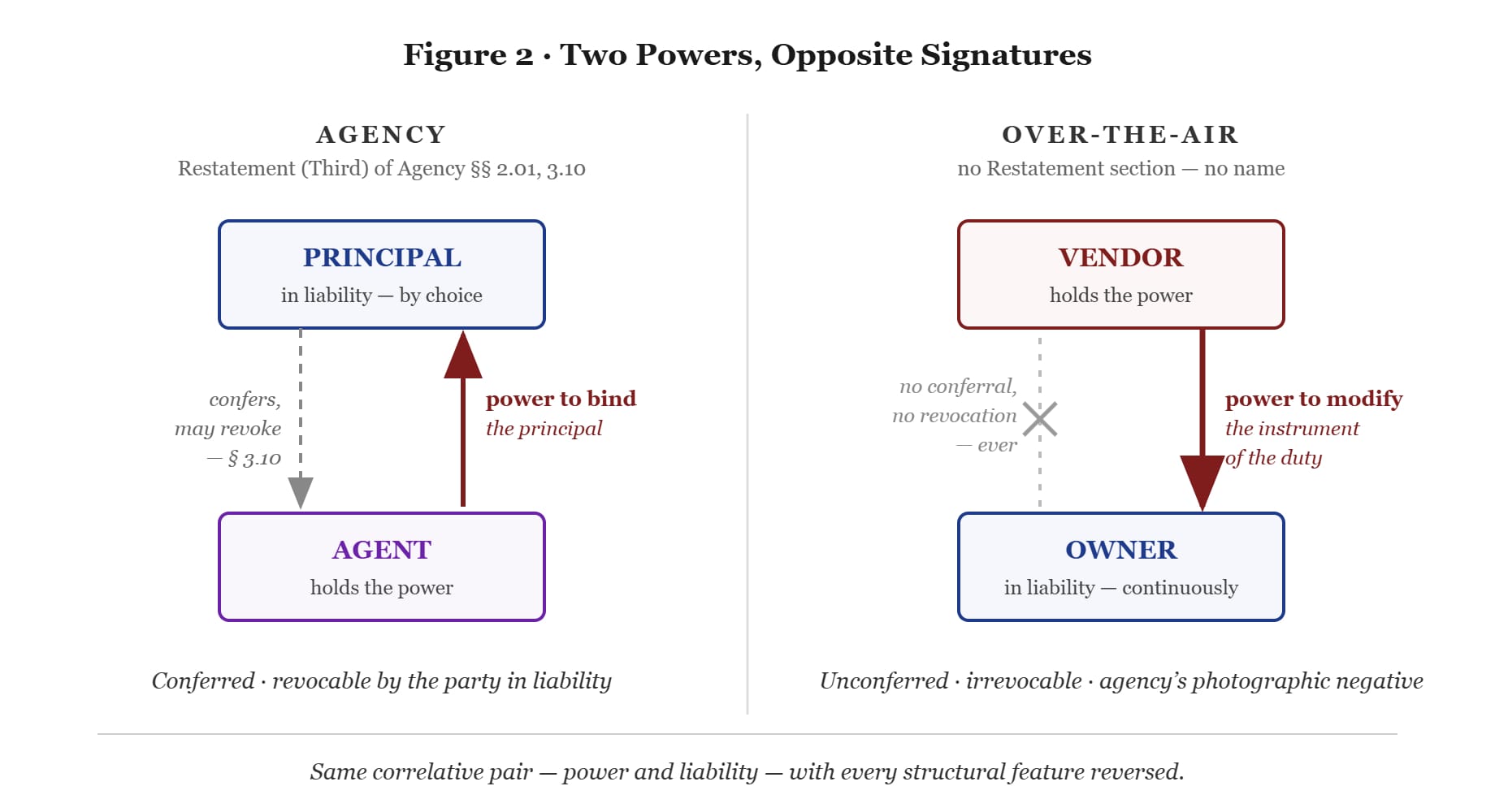
It isn't agency. In agency, the power flows from a conferral: the principal manifests assent, and the agent's power to affect the principal's legal relations comes into being — Restatement (Third) of Agency § 2.01. And the principal always retains the power to revoke. Section 3.10 is emphatic: notwithstanding any agreement to the contrary, actual authority terminates when the principal revokes it. Revocation may breach a contract; it is never beyond the principal's power.
Hohfeldian diagnosis: agency power is conferred and revocable by the very party who sits in liability to it. The OTA power is neither. The owner never granted it, and he cannot extinguish it — declining updates, where the interface permits it at all, degrades the product he owns and eventually its safety-critical components. A power the liable party neither granted nor can revoke is not agency, however much the "principal bears the consequences of another's acts" surface may resemble it. It is agency's photographic negative: liability without delegation.
Figure 2 — Left panel: agency, where the principal confers authority and always retains the power of revocation under § 3.10; the agent's power to bind is answered by a conferral channel running the other way. Right panel: the over-the-air relation, where the vendor's power to modify the instrument of the duty has no conferral and no revocation channel — the back-channel is simply absent.
It isn't classic products liability. Products doctrine is built on a snapshot: the Restatement (Third) of Torts: Products Liability § 2 asks whether the product was defective at the time of sale or distribution. The post-sale provisions, §§ 10 and 11, bolt on duties to warn and to recall — but those are duties to communicate about, or retrieve, the product that was sold. The whole architecture assumes the product is a fixed artifact that left the factory once.
Hohfeldian diagnosis: the snapshot assumption is the tell. Products doctrine has no slot for a power that keeps operating after sale, because the power keeps generating new products. The car that ran the stop sign in Key Largo was not, in any behaviorally meaningful sense, the car that left the factory; it was the car as of its most recent update. Which product do we test for defect, and as of when? If each push materially alters safety-relevant behavior, each push looks less like servicing a sold product and more like distributing a new one — with the time-of-sale clock restarting, and the design-defect analysis running against the newest firmware, forever. Plaintiffs' lawyers have noticed none of this yet at scale. They will.
It isn't anything else, either. Not bailment, not a servitude, not a license running with the chattel — though it behaves a little like all three, which is the tell that it's none of them. What we have is a retained vendor power operating continuously on an owner's non-delegable duty. The doctrine has no name for that relation because, until software ate the durable goods economy, the relation could not exist. Chattels didn't take instructions from their manufacturers after delivery.
Now consider an LLM
Here is where the relation stops being an automotive curiosity and becomes the central allocation problem of the agentic-AI economy.
A regional bank deploys an LLM agent to handle wire transfers. The agent reads payment instructions, verifies them against account records, and executes. This system — unlike the Tesla — is an agent in the full doctrinal sense: its acts alter third parties' legal relations as acts of the principal. When it wires funds, the bank's money moves as the bank's payment; when it confirms terms to a counterparty, the bank is bound. This is agency proper: a power conferred by the bank, revocable by the bank, exercised in the bank's name.
Now notice what else is in the room. The bank did not build the model. The model vendor — the frontier lab whose API sits under the agent — retains precisely the power Tesla retains over the Model S. A weights update ships. A safety patch changes refusal behavior. A quiet revision alters how the model parses ambiguous payment instructions, how aggressively it asks clarifying questions, how it handles a prompt-injection attempt embedded in an invoice memo field. The instrument through which the bank's agent exercises its delegated power has been modified — overnight, mid-deployment, by a party outside the agency relation entirely.
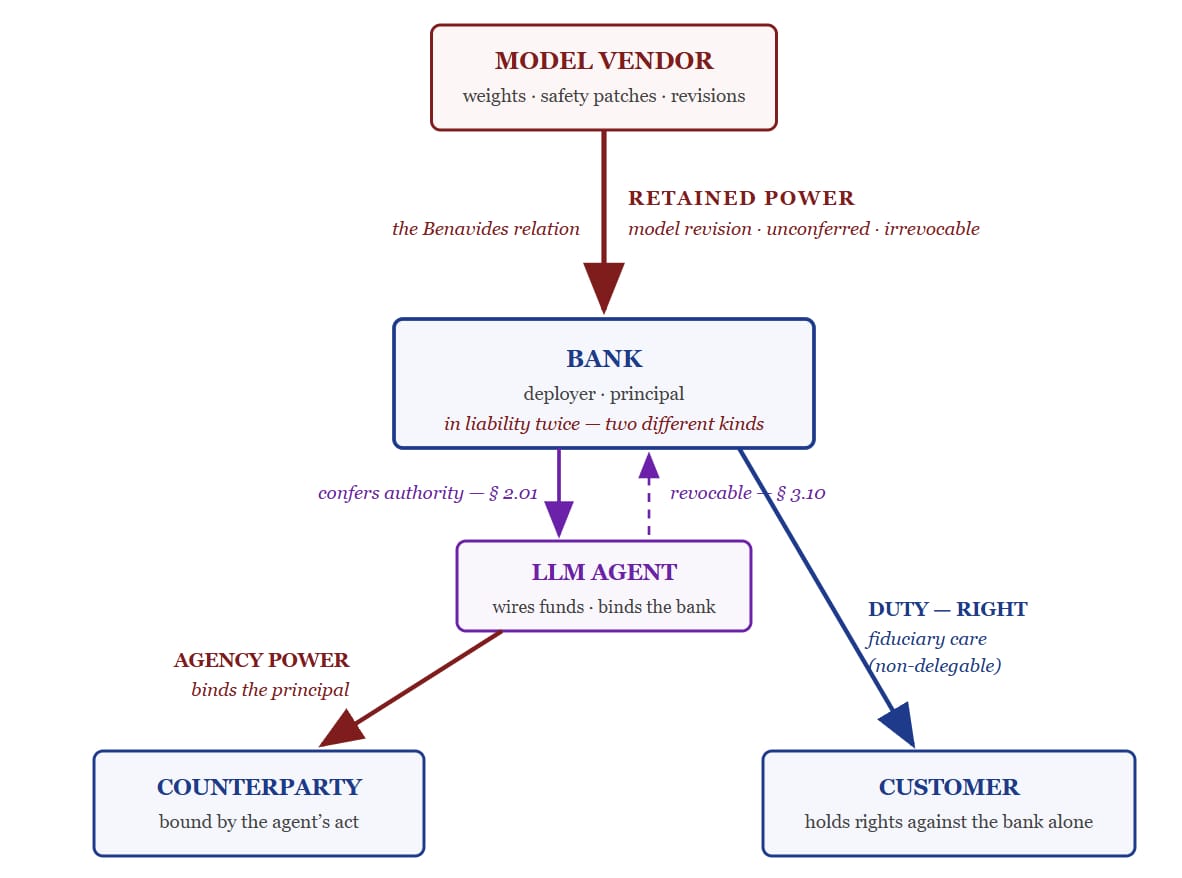
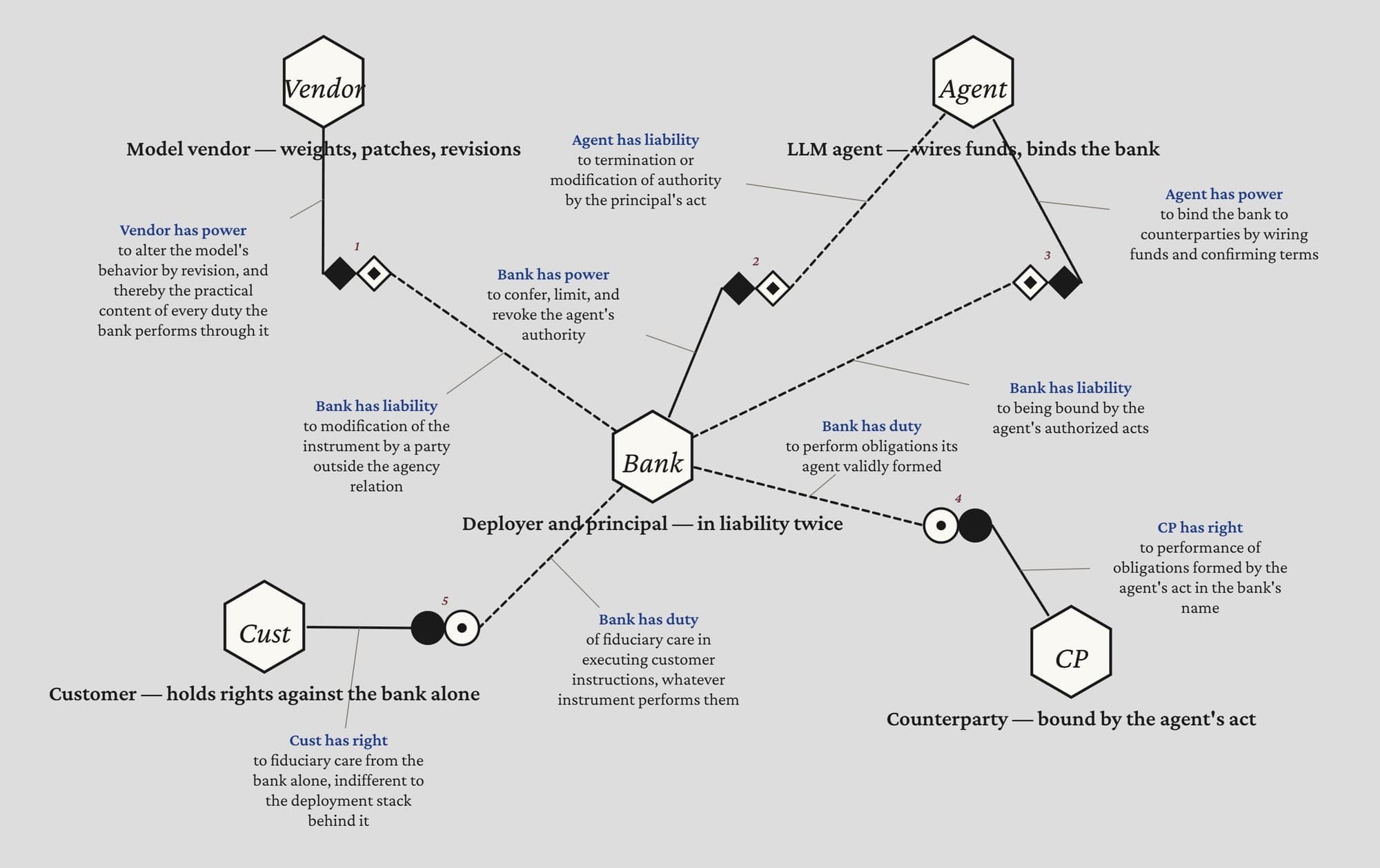
Figure 3 — The model vendor's retained power (the Benavides relation) runs down to the bank; the bank confers revocable authority on the LLM agent, whose agency power binds the bank to the counterparty; the bank's non-delegable fiduciary duty runs to the customer. The bank sits in liability twice, in two different kinds.
The Hohfeldian analysis, stated explicitly. The bank sits in two liabilities at once, and they are not the same kind:The agency liability (downward). To its counterparties, the bank is liable in the classical sense: susceptible to being bound by its agent's exercise of a power the bank conferred and could revoke tomorrow. Conferred, revocable — agency's signature.The Benavides liability (upward). To the model vendor, the bank is liable in the driveway sense: susceptible to having the behavior of its instrument — and therefore the practical content of every duty it owes its customers, regulators, and those same counterparties — rewritten by a power it never conferred and cannot revoke. The bank's fiduciary duty of care in executing customer instructions is non-delegable as against the customer. The vendor's version bump just changed what discharging it looks like. The structure from the driveway has reappeared inside the agency relation, one level up the stack.
Trace the bank's vertex in Figure 3 and you are tracing the whole allocation problem of the agentic economy. Every edge that touches the bank binds it — the retained power from above, the agency power exercised in its name below, the fiduciary duty running to the customer — and only one of those three edges is a relation the bank chose and can exit. The vendor's revision propagates down the red edges instantly and silently; the duties on the navy edge stay exactly where they were. Compare this figure to Figure 1: the driveway triangle is embedded in it, with the bank standing where the owner stood.
Figure 4 - Hohfeldian representation
Every serious question about AI agent liability lives at the junction of those two relations. The bank controls the deployment; the vendor controls the instrument; the customer holds rights against the bank alone. When the agent wires $2 million to a fraudster because last Tuesday's model revision handles injection attacks differently than the version the bank red-teamed, whose conduct do we test, against which version, as of when? The scope-of-employment cases won't answer it. The control test — who directs the manner of work? — collapses into paradox: the party with the most granular control over the agent's "manner of work" is the vendor, who is a stranger to the employment analogy altogether. The toolmaker can reach into the garage at night, and the master answers in the morning.
The statute that already noticed
One legal system has seen this clearly enough to legislate on it. The EU AI Act's value-chain provisions — Articles 25 and 26 of Regulation 2024/1689 — encode exactly the intuition the Hohfeldian analysis produces: obligations should track the power to modify. A deployer who substantially modifies a high-risk system steps into the provider's obligations; the party exercising the retained power over system behavior carries provider-grade duties for what that power does. Whatever one thinks of the Act's machinery, its allocation instinct is doctrinally correct — and it is correct because it follows the power. American law, still sorting these cases into the tort bucket and the contract bucket, has not yet noticed that the operative relation fits neither.
The relation, stated once
Strip everything else away and the structure is this:
A duty-bearer in continuous liability to a retained, unconferred, irrevocable power over the instrument of the duty's performance.
In the driveway, the duty is the driver's reasonable care and the power is Tesla's update channel. In the bank, the duty is the deployer's fiduciary and tort obligations and the power is the vendor's control over the model. Same relation, different altitude.
Agency doctrine spent eight centuries perfecting the analysis of conferred, revocable powers and the liabilities that follow them. It has no chapter on the unconferred, irrevocable kind — because until now, nobody could exercise a power like that over the tools of someone else's duty. That chapter is going to get written in the next decade, in courtrooms, by parties who mostly won't know what to call the thing they're litigating. You now do.
The verdict is Benavides v. Tesla, Inc. (S.D. Fla. 2025), post-trial motions denied February 2026, appeal pending in the Eleventh Circuit. Hohfeld's article is 23 Yale L.J. 16 (1913). The products provisions are Restatement (Third) of Torts: Products Liability §§ 2, 10–11; the agency provisions are Restatement (Third) of Agency §§ 2.01, 3.10; the value-chain provisions are Regulation (EU) 2024/1689, arts. 25–26.