The Intersection of Technology and Philosophy
After three decades architecting enterprise information systems, I've found that the most durable solutions emerge where technical precision meets philosophical clarity. I'm an Information Architect and Software Engineer specializing in AI-first language engineering — building domain-specific languages that let machines carry domain expertise faithfully rather than approximate it plausibly.
Technical Journey
Current Focus: Independent consultant working on Semantic AI Agents and agentic AI systems. I architect with Langium, TypeScript, and agentic tooling to build unified environments where language servers, diagram editors, and AI assistants operate against a shared formal model instead of trading loosely-worded strings.
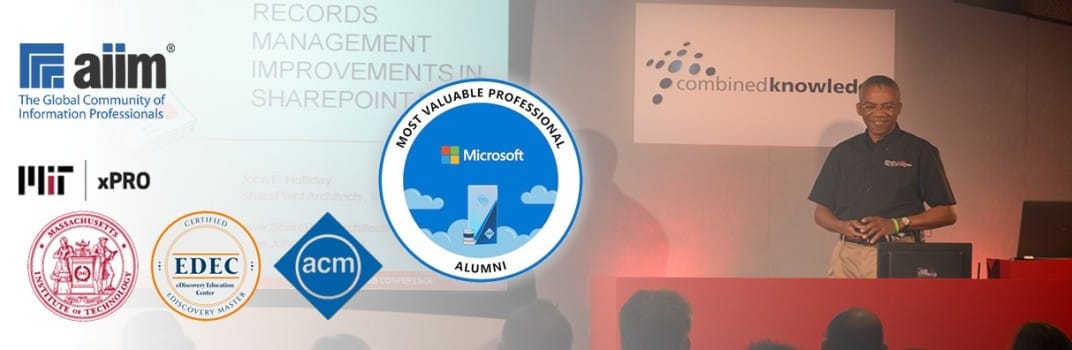
Foundation: 30+ years in Microsoft technologies, including five years as a Microsoft MVP and founder of the SharePoint Developer Network (14,000+ members). My approach to information architecture — codified in the Structured Relational Mapping (SRM) methodology — turns unstructured organizational knowledge into something you can actually query.
Innovation: Patent applicant for the Paragraph Management Software System. Developer of Hohfeldian Analytics™, a method and toolchain that treats Wesley Newcomb Hohfeld's eight jural relations — right, duty, privilege, no-right, power, liability, immunity, disability — as a type system for legal doctrine.
The lineage runs back forty years, in two separate pieces:
- At the University of Michigan in the mid-1980s, while studying law and computational linguistics, I built a LISP expert system that recognized Hohfeldian jural relations in natural-language expressions. It ran interactively on a university mainframe. It produced no graphics of any kind.
- Later, as a post-graduate fellow at the Institute for Legal Documentation (IDG) in Florence, I developed a graphical notation for the language-neutral expression of legal norms. Entirely by hand. No computer was involved.
Neither effort knew about the other. Forty years on, the DSL is the first thing that joins them.
Academic Foundation
- J.D. University of Michigan Law School
- A.B. Applied Mathematics Harvard University
The combination is less exotic than it sounds and more useful than it looks: mathematical logic supplies the rigor, legal reasoning supplies the tolerance for ambiguity, and building AI systems requires both at once.
The Law of Agents
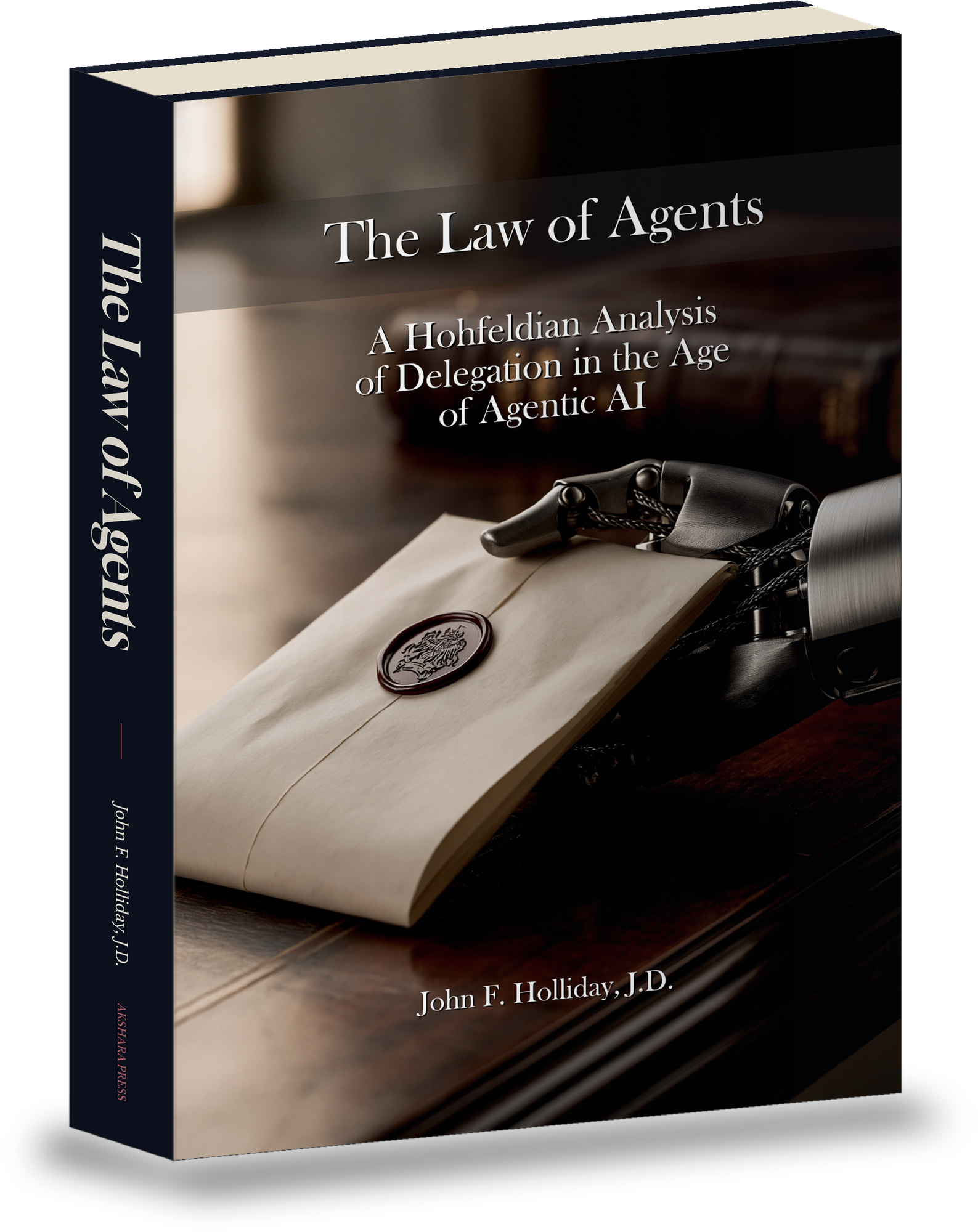
Book, January 12, 2027. The Law of Agents: A Hohfeldian Analysis of Delegation in the Age of Agentic AI asks a question the AI industry has been answering badly by answering it accidentally: when a principal delegates authority to an agent, who bears the consequences?
Agency law has been working on that question since the thirteenth century. Apparent authority, ratification, the duty of loyalty, respondeat superior — these are not analogies imported to make AI governance sound respectable. They are the accumulated case law of delegation under uncertainty, and they map onto agentic AI systems with uncomfortable precision. When an LLM invokes a tool nobody authorized, the doctrine already has a name for that. When a vendor accepts the benefit of an agent's unauthorized act, the doctrine already knows what happens next.
The book is in three parts:
| Part | Subject |
|---|---|
| I | Principal and Agent — formation, the four jural relations, actual and apparent authority, ratification, termination, imputation |
| II | Fiduciary Duties — loyalty, care, obedience, disclosure, accounting, mapped to hallucination, prompt injection, data exfiltration, tool selection, and multi-tenancy |
| III | Respondeat Superior — scope of employment, why the control test fails for AI, EU AI Act Articles 25–26, allocation across the deployment stack, cross-border liability |
Throughout, doctrine is expressed in Hohfeldian terms and rendered diagrammatically, so that a claim about who holds a power and who bears the correlative liability can be checked rather than merely asserted.
Written for general counsel, AI governance leads, platform architects, and protocol designers. Published by Akshara Press in hardcover and ebook.
Learn more at law-of-agents.johnholliday.net — sample topics, the Hohfeld Playground, and release notification signup.
Beyond the Code

Philosophical Practice: Student of Vedic philosophy under Gurudev Sri Sri Ravi Shankar. I practice and teach Vedic meditation, finding that ancient wisdom provides essential perspective on modern technological challenges. My book, Truth Alone Triumphs, applies timeless Vedic frameworks to contemporary American issues.
Creative Pursuits: Jazz fusion enthusiast (Pat Metheny, Yellowjackets, David Sanborn). Woodworker crafting custom furniture. Permaculture gardener designing regenerative systems on Amelia Island, Florida. Lifelong vegetarian.
What I Offer
- Custom DSLs that encode domain expertise as executable specification
- VS Code extensions and Eclipse Theia IDEs for domain-specific development environments
- Agentic AI architecture, with attention to authority, delegation, and liability boundaries
- Unstructured information transformed into structured, queryable knowledge
Current Projects
- The Law of Agents — treatise on agency doctrine and agentic AI, released January 12, 2027
- Hohfeldian Analytics™ DSL — Langium grammar and rendering toolchain for diagrammatic doctrinal analysis; the figures in the book are generated from it
- Language Engineering — Langium grammars for legal analysis, regulatory compliance, records management, cybersecurity assessment, AI readiness, change management, and document composition
- Technical Writing — AI-first development, semantic dissonance in multi-agent systems, and why MCP needs a type system
Connect
Based on Amelia Island, Florida, working with clients globally who want principle-driven approaches to technology transformation.
Email: john@johnholliday.net LinkedIn: https://linkedin.com/in/holliday
"Technology should amplify human wisdom, not replace it. The best systems emerge when we honor both ancient principles and modern possibilities."